
Artificial Intelligence (AI) Policy
I. Introduction
St. Michael’s College of Iligan, Inc. (SMCII) believes that Artificial Intelligence (AI) is a powerful partner in transforming education. When used responsibly, AI deepens reflection, strengthens performance, and supports values-based formation. Guided by the RVM pedagogy of faith, excellence, and service, this policy ensures that AI serves the holistic growth of learners—helping them think critically, act compassionately, and engage authentically with their learning.
AI is introduced not as a shortcut, but as a meaningful learning companion that empowers students to reflect, create, and grow. Rooted in Ignacian-Marian education, this policy ensures that AI use is always human-centered, ethical, and aligned with the mission of nurturing competent and compassionate leaders.
II. Purpose
This AI Policy aims to:
- Ensure that AI is used to enhance learning, reflection, and student formation.
- Align AI practices with RVM pedagogy and the values of faith, excellence, and service.
- Promote meaningful, ethical, and compassionate use of AI.
- Foster student growth through reflective and performative learning experiences.
- Uphold authenticity, honesty, and academic integrity.
- Ensure compliance with CHED, DepEd, ISO 21001:2018, and PAASCU standards.
III. Scope
This policy applies to:
- Students (Basic Education, Higher Education, and Graduate School)
- Faculty and Academic Staff (teaching, research, assessment)
- Administrative Personnel (records, HR, finance, communication)
- External Partners and Service Providers
IV. Guiding Principles
- Faith and Integrity – AI must uplift human dignity, respect cultural and spiritual contexts, and support human formation.
- Excellence – AI enhances thinking, creativity, and performance but never replaces genuine human effort.
- Service – AI use must promote inclusion, accessibility, and care for the community.
- Authenticity – Learners must use AI honestly, with transparency and acknowledgement of its role in their work.
- Accountability – Users remain responsible for AI-assisted work.
- Reflective Practice – AI must strengthen metacognition—helping learners analyze, reflect, and improve.
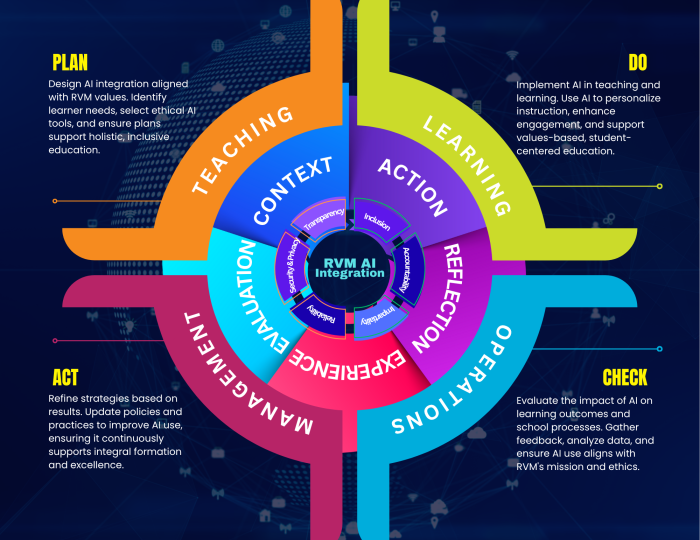
V. Framework for AI Integration (RVM AI Framework)
AI integration follows a continuous improvement cycle:
- Plan (Teaching–Context): Design responsible AI use aligned with learning outcomes, learner needs, and RVM formation goals.
- Do (Learning–Action): Implement AI in instruction to personalize learning, enhance engagement, and support values-based education.
- Check (Operations–Reflection): Evaluate AI’s impact on learning outcomes, gather feedback, analyze data, and ensure alignment with institutional ethics.
- Act (Management–Evaluation): Refine strategies, update policies, and ensure AI contributes to holistic formation and educational excellence.
This cycle ensures that AI is not only a technological tool but a formation tool for learners and educators.
VI. Acceptable Uses of AI
Artificial Intelligence (AI) has the potential to enhance the learning experience, teaching practices, research initiatives, and administrative services of SMCII. However, its use must always remain responsible, ethical, and aligned with human creativity and school core values. Below are the acceptable uses, with detailed explanations:
- For Students
AI tools can be a valuable support system, but students must use them to supplement, not replace, their own effort and learning.
- Research Assistance – AI can help students explore topics, gather summaries of academic articles, or simplify complex texts. Example: Using AI to summarize a 20-page journal article to highlight key points before doing deeper reading.
- Brainstorming & Idea Generation – Students may use AI to brainstorm essay topics, project outlines, or creative ideas, provided they critically evaluate and refine the output.
- Skill Development – AI-powered simulations (for finance, business, language, or coding exercises) can help students practice skills before applying them in real-world tasks.
- Language Support – Students struggling with grammar, translation, or academic writing may use AI to improve clarity, but the final work must be their own original thought.
- Study Aids – Students can use AI chatbots for practice quizzes, flashcards, and concept reinforcement but not for answering graded assessments directly.
- For Faculty and Academic Staff
Faculty are encouraged to use AI as a teaching and research enhancement tool, while maintaining academic rigor and integrity.
- Instructional Materials Preparation – AI can help in creating lecture slides, case studies, examples, or simplified explanations of difficult concepts, saving time and enhancing clarity.
- Student Engagement – Faculty can use AI to design interactive quizzes, games, or discussion prompts that make learning more engaging and inclusive for diverse learners.
- Research Support – AI can assist in literature reviews, data analysis, statistical modeling, and identifying gaps in current research. Faculty, however, must validate outputs for academic credibility.
- Assessment Assistance – AI may help draft rubrics, sample test items, or feedback templates. However, grading and evaluation must remain a human responsibility to ensure fairness and contextual judgment.
- Academic Innovation – Faculty may experiment with AI for blended learning, flipped classrooms, or personalized learning strategies that support different learning paces and styles.
- For Administrative Staff
AI can streamline operations and decision-making in the College, provided confidentiality and data privacy are strictly observed.
- Routine Automation – Tasks like scheduling meetings, drafting memos, managing forms, and generating reports can be automated through AI-powered systems to improve efficiency.
- Communication Enhancement – AI can draft official communications, announcements, or newsletters that staff can then review, edit, and finalize for accuracy.
- Data Organization & Insights – Staff may use AI to analyze student satisfaction surveys, enrollment patterns, or financial trends, helping administrators make evidence-based decisions.
- Record-Keeping – AI can support organizing archives, indexing files, and ensuring quick retrieval of institutional records while following the Data Privacy Act of 2012.
- Student Services – Chatbots or AI assistants can provide quick responses to common student queries (e.g., enrollment steps, scholarship requirements, library use), improving accessibility.
VII. Unacceptable Uses of AI
While AI offers many benefits, misuse can harm learning, integrity, and institutional trust. The following are strictly prohibited and will be subject to disciplinary action:
- Submitting AI-Generated Work as One’s Own without Acknowledgment
- Students or faculty must not present AI-generated essays, reports, research, or presentations as original human work.
- Proper acknowledgment is required when AI is used (e.g., citing it as a tool for drafting or summarization).
- Example of misuse: A student pastes an AI-written research paper and submits it without any revisions or citation.
Why it is unacceptable: It undermines academic integrity, erodes trust, and prevents authentic learning.
- Using AI for Plagiarism, Academic Dishonesty, or Bypassing Critical Thinking
- AI must not be used to answer exams, write entire theses, or produce assignments without effort from the student.
- Copy-pasting AI outputs into coursework without proper reflection or analysis is prohibited.
- Faculty/staff must not use AI to create reports or evaluations without reviewing and validating them.
Why it is unacceptable: Education at SMCII is designed to develop independent thinking, creativity, and problem-solving. Over-reliance on AI prevents growth and violates standards of academic honesty.
- Creating or Spreading Misinformation, Deepfakes, or Unethical Content
- Using AI to generate false information, manipulated media, or offensive content (racist, violent, discriminatory) is strictly forbidden.
- Example: Creating AI-edited images or videos to harm another person’s reputation.
- Students and staff must not use AI to fabricate academic sources, fake data, or create misleading statistics.
Why it is unacceptable: Such actions damage credibility, harm individuals, and contradict Catholic values of truth and justice.
- Sharing Confidential Institutional or Personal Data with Unsecured AI Platforms
- Sensitive information such as student records, grades, finances, HR data, contracts, or private communications must never be uploaded into unsecured or public AI tools.
- Example of misuse: An employee copying student ID numbers or financial reports into a free AI website for processing.
Why it is unacceptable: It violates the Data Privacy Act of 2012 (RA 10173) and risks exposing SMCII’s community to identity theft, fraud, and institutional harm.
- Over-Reliance on AI in Areas Requiring Human Judgment, Empathy, and Values-Based Decision-Making
- AI should not replace human involvement in areas that require emotional intelligence, discernment, and moral reasoning.
- Examples of misuse:
- A guidance counselor relying solely on AI to give advice to students.
- Administrators using AI-generated evaluations without personally engaging with staff.
- Faculty allowing AI to grade essays without human review.
Why it is unacceptable: AI lacks compassion, cultural sensitivity, and ethical responsibility—core values that are essential in education and community service.
VIII. Data Privacy and Security
- Compliance with the Data Privacy Act of 2012 (RA 10173).
- Secure and encrypted platforms must be used.
- AI must not compromise institutional IT policies.
IX. Implementation and Monitoring
- Oversight: Quality Assurance Office (QAO) with IT, Academic Affairs, and Administration.
- Training: Orientation for faculty, staff, and students on ethical AI use.
- Monitoring: Plagiarism checkers and AI-detection tools.
- Review: Policy updated every two years or as needed.
X. Sanctions
- Students: Grade penalties, suspension, or disciplinary action.
- Faculty/Staff: Administrative sanctions, restricted access.
- Partners: Contract termination.
XI. Alignment with the Rome Call for AI Ethics
This policy adopts the Rome Call for AI Ethics (2020), which emphasizes:
- Transparency – Clear, understandable AI use.
- Inclusion – Ensuring no student or community is left behind.
- Accountability – Human responsibility for AI actions.
- Impartiality – Avoiding bias and discrimination.
- Reliability – Ensuring accuracy and trustworthiness of AI tools.
- Security & Privacy – Protecting personal and institutional data.
By following this framework, SMCII affirms that AI must always serve human dignity, educational integrity, and the common good.