
Crisis Management Response
I. Rationale
St. Michael’s College of Iligan, Inc. (SMCII) upholds the safety, well-being, and holistic formation of all learners and personnel as a core institutional responsibility. In an educational environment where natural disasters, accidents, health emergencies, and security threats may occur, a clear and organized Crisis Management Response is essential. Guided by the RVM values of faith, excellence, and service, this policy ensures that the school can prevent, prepare for, respond to, and recover from crises in a timely and compassionate way. It strengthens institutional resilience, promotes coordinated action, and protects the entire Michaelite community.
II. Purpose
This policy aims to provide an organized system for managing crises across the institution. Specifically, it seeks to:
- Ensure the safety and protection of students, employees, and visitors.
- Establish clear procedures for prevention, preparedness, response, and recovery.
- Promote coordinated action among administrators, academic units, and support offices.
- Reduce the impact of emergencies on learning continuity and operations.
- Strengthen institutional readiness through training, communication, and documentation.
- Comply with CHED, DepEd, DRRM, ISO 21001:2018, and PAASCU standards.
III. Scope
This Crisis Management Response Policy applies to the entire SMCII community, including:
- Students in the Basic Education, Higher Education, and Graduate School levels;
- Faculty and Academic Staff involved in instruction, research, and assessment;
- Administrative Offices and Personnel involved in operations, security, communication, health services, records, logistics, and finance;
- Campus Visitors, Partners, and Service Providers during official transactions or activities;
- All SMCII Units and Campuses, including buildings, grounds, and off-site learning or outreach activities.
IV. Curriculum Development Framework
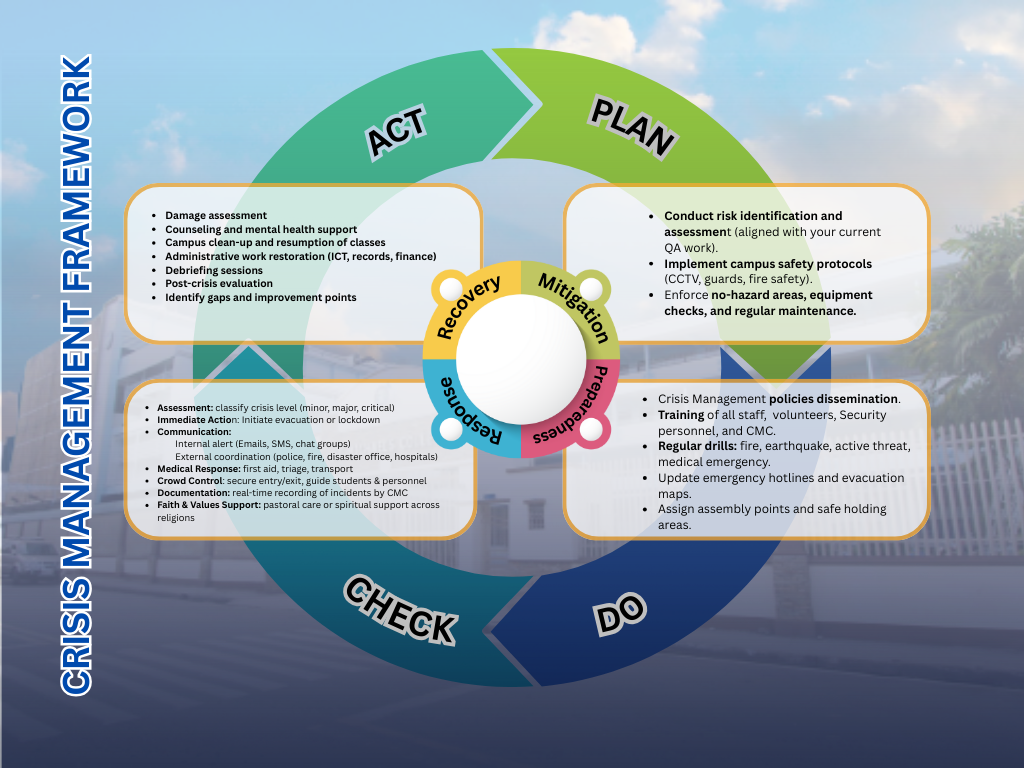
Figure 1. CRISIS MANAGEMENT FRAMEWORK
The Crisis Management Framework shows how SMCII prepares for, responds to, and recovers from emergencies using a clear and continuous improvement cycle. In the Plan stage, the school focuses on mitigation and preparedness by assessing risks, enforcing safety protocols, training staff, and conducting regular drills. The Do stage covers the actual crisis response, which includes assessing the situation, initiating evacuation or lockdown, coordinating communication, providing medical aid, ensuring crowd control, and offering spiritual or pastoral support. The Check stage begins after the crisis, where the school assesses damages, provides counseling, restores operations, and evaluates what happened. Finally, the Act stage uses all lessons learned to improve policies, update protocols, and strengthen future readiness. This cycle ensures that SMCII remains safe, resilient, and continuously improving in crisis handling.
V. Policy on Suspension of Classes and Safety Procedures
A. Authority to Suspend Classes
Primary Decision-Maker: The College President has the primary authority to declare the suspension of classes and work during natural disasters in coordination with the Vice President for Administration (VP- Admin ) and Vice President for Academic Affairs (VP - Acad).
In Absence of President: The President for Administration (VP- Admin ) and Vice President for Academic Affairs (VP - Acad) shall take charge of declaring class suspensions.
If the President fails to respond within five (5) minutes from the occurrence of an emergency, the following officials, acting as consultative decision-makers, are authorized to declare the suspension of classes and initiate evacuation procedures:
- Physical In-Charge
- Vice President for Academics and Vice President for Administration
- The school principal is in charge in case of his/her absence.
B. Policy on Earthquake
| Basic Education Department (BED) (Kinder-G12) | Magnitude 2.5 or higher: Automatic class suspension anytime of the day, even without an official notice. |
| Higher Education Department (HED) (College/Grad) | Magnitude 3.0 or higher: Automatic suspension of classes for all college and graduate levels, no notice required. |
| Administrative and Office Personnel | Magnitude 3.5 or higher: All office transactions shall be automatically suspended. All administrative and non-teaching personnel shall secure their respective work areas and immediately vacate the premises once safety protocols are observed. |
This provision is pursuant to the Philippine Disaster Risk Reduction and Management Act of 2010 (Republic Act No. 10121), which mandates the protection of life and safety during disasters and emergencies.
Classes and work operations shall remain suspended until the SMCII Safety and Security Committee and the local DRRMO confirm that all facilities are structurally safe for occupancy.
However, the suspension of classes shall be automatic upon the issuance of an order from the National or Local Government.
- During the Earthquake:
- Stay calm and perform Duck, Cover, and Hold under sturdy furniture.
- Avoid windows, glass, and heavy objects.
- Remain inside until shaking stops.
- After the Earthquake:
- Once shaking stops, evacuate calmly through designated exit routes toward the open evacuation areas.
- Teachers must lead and account for all their students at the designated safe zones.
- The Safety and Security Committee and the School Nurse shall check for injuries and assist those in need.
- Wait for the “All Clear” signal before re-entering buildings.
- Vehicle Regulation (HED Quadrangle):
- In emergencies, vehicles parked inside the quadrangle shall be the last to exit to allow students and personnel to evacuate safely, as this serves as the main exit gate.
- Parental and Guardian Protocol (BED):
- During emergency pick-ups, only parents or authorized guardians shall be allowed to claim learners.
- They must present their valid Identification Card (ID) at the gate or designated release area.
- No learner shall be released to an unauthorized person for safety reasons.
C. Policy on Typhoon
C.1. When to Suspend ClassesAutomatic suspension for Pre-school and Kindergarten.
Automatic suspension for all levels (BED and HED)
Automatic suspension for office work.
Localized Suspension: If PAGASA has not issued an advisory, but local flooding, power outages, or unsafe travel conditions exist, the President or authorized officials (as stated in Section II) may declare class suspension.
Announcements shall be made via:
- Official SMCII Facebook page
- Website and text advisories.
However, the suspension of classes shall be automatic upon the issuance of an order from the National or Local Government.
C.2. What to Do Before, During, and After a Typhoon- Before:
- Secure documents, electrical devices, and learning materials.
- Faculty and staff must ensure classrooms and offices are storm-ready.
- Stay updated via SMCII’s official announcements.
- During:
- Students on campus must remain in safe areas until an official dismissal is announced.
- Avoid flooded or open areas and downed electrical lines.
- After:
- The Physical Plant Office and Safety and Security Committee will inspect facilities for possible damage.
- Resumption of classes and work will only occur after the President or authorized official declares the campus safe.
VI. Communication and Coordination
All announcements regarding class suspension and resumption will be officially released by the Office of the President or the VP for Administration through:
- Official SMCII Social Media Pages
- Text and Email Advisories
- Campus Bulletin Boards
VII. Implementation and Review
This policy takes effect immediately upon approval by the College President and shall be implemented across all departments through the coordinated efforts of the Vice President for Administration, School Principals, and the Safety and Security Committee.
Regular feedback and evaluation shall be conducted after every actual calamity event or scheduled emergency drill to assess the effectiveness of the procedures and identify areas for improvement. The Quality Assurance Office, in coordination with the Crisis Management Committee, shall compile feedback from faculty, staff, students, and parents to enhance readiness and response measures.
This policy shall be reviewed annually by the Quality Assurance Office and the Crisis Management Committee to ensure alignment with updated national and local disaster risk reduction and management standards and institutional safety protocols.