
Curriculum Development Framework
I. Rationale
The SMCII Curriculum Development Framework is established to ensure that all academic programs remain relevant, holistic, and strongly aligned with the institution’s VMGO, Catholic Ignacian–Marian identity, and national and global standards. With an Outcomes-Based Education (OBE) approach integrated into the PDCA quality cycle, the framework guarantees that curriculum planning, implementation, evaluation, and continuous improvement are evidence-based, stakeholder-driven, and responsive to societal and industry needs. It strengthens SMCII’s commitment to forming competent, compassionate, and value-oriented Michaelite graduates.
II. Purpose
The purpose of the SMCII Curriculum Development Framework is to guide the systematic design, delivery, assessment, and enhancement of academic programs. It aims to ensure that learning outcomes are clearly defined, effectively taught, accurately assessed, and consistently improved. The framework serves as a unified institutional guide for curriculum development that promotes quality education, learner-centered teaching, continuous improvement, and strong collaboration among stakeholders.
III. Scope
This framework applies to all academic programs across Basic Education, Higher Education, and Graduate School departments of St. Michael’s College of Iligan, Inc. It covers the full curriculum life cycle—planning, design, implementation, monitoring, evaluation, and continuous improvement. It also defines the roles of key stakeholders—including faculty, students, parents, alumni, and industry partners—in providing input and feedback to ensure curriculum relevance, compliance with DepEd, CHED PSGs, PAASCU, ISO 21001:2018, and integration of SDGs and Ignacian–Marian values.
IV. Curriculum Development Framework
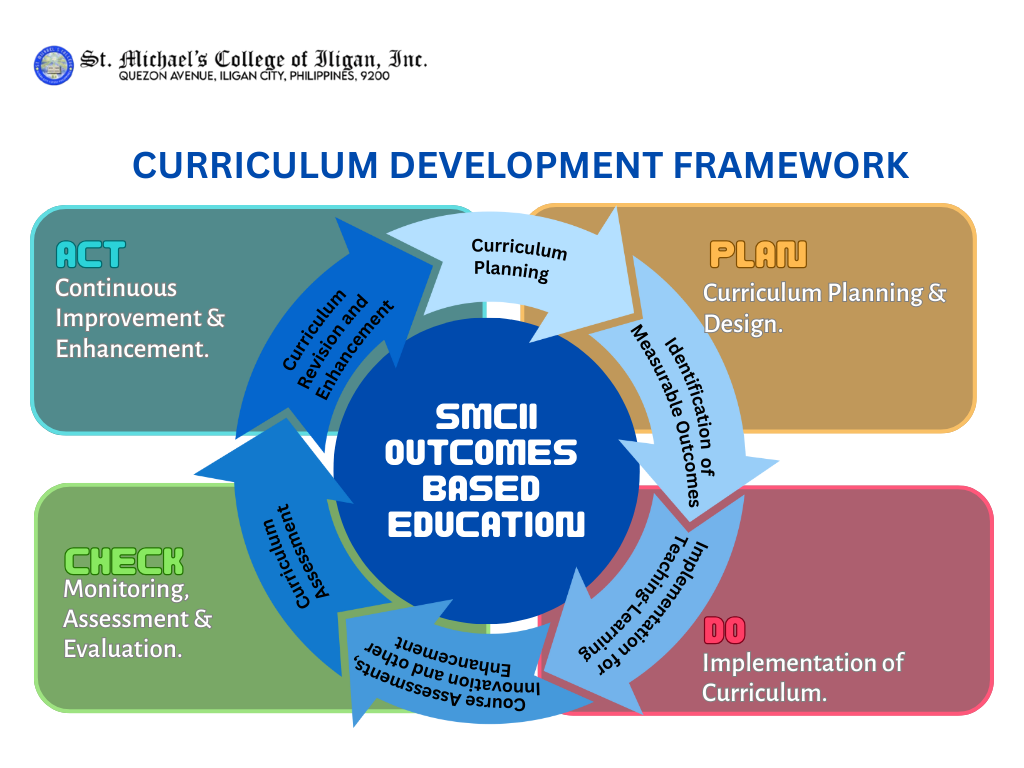
Figure: SMCII CURRICULUM DEVELOPMENT FRAMEWORK
The St. Michael’s College of Iligan, Inc. (SMCII) Curriculum Development Framework is a holistic, cyclical, and outcomes-based model that ensures the curriculum is continuously aligned with the institution’s VMGO, national and global standards, industry needs, and learner development. Anchored on Outcomes-Based Education (OBE) and driven by the PDCA (Plan–Do–Check–Act) quality cycle, the framework guarantees that all programs remain responsive, relevant, and transformative.
At the center of the framework is the core mission of SMCII to produce competent, compassionate, and value-driven Michaelite graduates who embody Faith, Excellence, and Service. Surrounding this central purpose is a continuous flow of interconnected processes that guide curriculum development, implementation, evaluation, and improvement.
This phase ensures that the curriculum is systematically prepared, aligned, and grounded on SMCII’s VMGO, DepED, CHED PSGs, PAASCU standards, SDGs, and stakeholder needs.
The planning stage sets the foundation for the entire curriculum development cycle. It starts with Curriculum Planning, which includes consultations, needs assessments, benchmarking, and review of CHED PSGs, PAASCU recommendations, ISO 21001 standards, and global trends. This ensures that programs are built on updated, evidence-based information.
This phase also includes the Identification of Measurable Outcomes, where Institutional Outcomes (IOs), Program Outcomes (POs), and Course Learning Outcomes (CLOs) are defined and aligned. These outcomes reflect both academic expectations and SMCII’s core values. The result is a curriculum that is coherent, structured, and mapped to ensure students develop the needed knowledge, skills, and values.
The PLAN stage answers the questions:
- What should students learn?
- How do these outcomes support institutional goals?
- What standards guide the program?
Components of the PLAN Phase:
- Curriculum Planning
- Conduct sessions and surveys with teachers, students, parents, alumni, and industry partners.
- Review CHED PSGs, ISO standards, PAASCU recommendations, and international benchmarking.
- Identify gaps in relevance, skills, content, and employability.
- Identification of Measurable Outcomes
- Define IOs, POs, and CLOs aligned with OBE and Michaelite graduate attributes.
- Prepare CLO–PO–IO matrices and performance indicators.
- Integrate SDGs and Ignacian-Marian values into outcomes.
- Curriculum Mapping & Design
- Create or revise syllabi (OBE format).
- Identify teaching strategies, resources, and assessments.
- Set learning standards and competencies per course.
This is the execution phase, where teaching, learning, and curriculum innovations occur.
After planning, the curriculum is put into action. This includes classroom instruction, innovation in teaching strategies, integration of values, development of learning activities, and the delivery of lessons and modules. Faculty members implement the curriculum using pedagogical approaches that promote:
- Active learning
- Experiential learning
- Digital and blended learning
- Research and community involvement
- Industry-required competencies
The Course Assessments, Innovation, and Other Enhancement phase is part of this stage. It ensures that assessments such as tests, performance tasks, portfolios, competencies, and capstone projects are aligned with CLOs and POs.
The DO stage answers the questions:
- How is the curriculum delivered in the classroom?
- Are teaching strategies aligned to outcomes?
- Are assessments appropriate and meaningful?
Components of the DO Phase:
- Teaching–Learning Implementation
- Faculty implements lessons using active, innovative, and values-integrated strategies.
- Use digital platforms, experiential learning, and blended modalities.
- Course Assessments and Instructional Delivery
- Conduct OBE-aligned assessments: formative and summative.
- Apply rubrics, performance tasks, practicum, research outputs, and capstone projects.
- Curriculum Innovations & Enhancements
- Integrate SDGs, community engagement, international internships, and research.
- Update instructional materials and modules.
This phase focuses on reviewing the effectiveness and alignment of the curriculum. The CHECK phase ensures quality assurance. Here, the effectiveness of implementation is monitored through various tools:
- Course and program assessments
- Student evaluations of teaching
- Industry feedback and internship evaluations
- Alumni tracer studies
- Stakeholder surveys
- Curriculum assessment documents
This stage involves analyzing whether learning outcomes are being achieved, whether assessments are valid, and whether teaching-learning activities support student success.
Curriculum Assessment and Curriculum Evaluation occur here, focusing on measuring the strengths, gaps, and alignment of the curriculum to standards and desired competencies.
The CHECK stage answers the questions:
- Are the intended outcomes being met?
- What evidence supports curriculum effectiveness?
- What areas need improvement?
Components of the CHECK Phase:
- Curriculum Assessment
- Evaluate CLO–PO achievement through course reports.
- Review teaching effectiveness via student evaluations.
- Program Performance Monitoring
- Conduct tracer studies, employer feedback, internship evaluations.
- Review licensure performance (if applicable), retention, and graduation rate.
- Compliance and Quality Review
- PAASCU/ISO 21001:2018 internal audits
- Curriculum metrics vs target mechanism results
- Stakeholder satisfaction evaluations
This phase implements improvements based on evaluation results and closes the PDCA cycle. It institutionalizes best practices and addresses gaps. The final stage, ACT, ensures that curriculum development is a continuous cycle rather than a one-time process. Based on the data gathered during the CHECK phase, improvements are introduced to enhance curriculum quality. This may include:
- Revising learning outcomes, updating syllabus content, and modifying assessments
- Integrating new teaching strategies and adding new electives or removing outdated content
- Strengthening industry linkages and updating instructional materials
- Enhancing faculty qualifications and implementing new policies
This stage embodies SMCII’s commitment to lifelong learning, excellence, and responsiveness to educational demands.
The ACT stage answers the questions:
- How do we improve the curriculum?
- What changes are needed to enhance learning outcomes?
- How can we better serve students and stakeholders?
Components of the ACT Phase:
- Curriculum Revision & Enhancement
- Update syllabi, contents, learning outcomes, teaching strategies, and assessments.
- Introduce new courses or elective offerings responding to industry needs.
- Policy and System Improvements
- Improve teaching standards, assessment policies, and monitoring tools.
- Strengthen linkages and partnerships with industries and communities.
- Capacity Building & Faculty Development
- Offer training, seminars, benchmarking visits, and certification programs.
- Sustain competency standards for Michaelite educators.
- Documentation & ISO QMS Integration
- Update reports, manuals, and SOPs.
- Comply with accreditation and regulatory updates.
Stakeholder Participation in the SMCII Curriculum Development Framework
St. Michael’s College of Iligan, Inc. recognizes that an effective and responsive curriculum is built not only on academic standards but also on meaningful involvement from the community it serves. As a Catholic, Ignacian–Marian institution committed to forming competent and value-driven Michaelites, SMCII places high importance on engaging its stakeholders teachers, parents, alumni, students, and industry partners through clearly defined criteria that ensure informed, responsible, and purposeful participation in curriculum development.
Stakeholder involvement strengthens the curriculum by promoting relevance, inclusivity, accountability, and innovation. Each stakeholder group brings distinct perspectives that help shape academic programs aligned with societal needs, workforce demands, global standards, and the Michaelite ethos.
The following criteria guide the identification and engagement of stakeholders in the curriculum development process.
A. Teachers / Faculty
Teachers serve as the primary implementers of the curriculum and are crucial contributors to planning, designing, assessing, and improving academic programs. Faculty participation is guided by the following criteria:
- Expertise in Subject Area and Updated Knowledge: Faculty participants must possess strong academic preparation and up-to-date knowledge in their disciplines. Their expertise enables them to identify content accuracy, current trends, and essential competencies to be embedded in the curriculum.
- Ability to Align CLOs with Program and Institutional Outcomes: Teachers are expected to understand and apply outcomes-based education (OBE). They should be capable of mapping Course Learning Outcomes (CLOs) to Program Outcomes (POs) and Institutional Outcomes (IOs), ensuring curricular coherence and alignment with SMCII’s mission.
- Innovative and Pedagogically Sound Teaching Strategies: Faculty members chosen for curriculum work must demonstrate the ability to integrate innovative, learner-centered, and Ignacian–Marian pedagogy, ensuring that the curriculum fosters critical thinking, values formation, and holistic learning experiences.
- Evidence of Industry Practice, Research Engagement, or Certifications: Faculty with relevant industry experience, research outputs, or professional certifications contribute practical, real-world perspectives. This ensures the curriculum remains aligned with current job market needs and professional standards.
- Commitment to Michaelite Values and Student-Centered Learning: Teachers participating in curriculum development must uphold the SMCII core values of Faith, Excellence, and Service. They serve as role models in designing curricula that inspire moral development, compassion, and responsible citizenship.
- Use of OBE-Aligned Rubrics and Fair Assessment Practices: Faculty must demonstrate the ability to design valid, reliable, and outcomes-based assessments. This ensures that curriculum content and evaluation strategies support student mastery and fairness.
B. Parents
Parents provide important insights into learner development, home environment realities, and expectations for education. Their participation ensures that the curriculum remains sensitive to student welfare and family dynamics.
- Provide Insights on Learner Behavior, Needs, and Family Expectations: Parents offer valuable perspectives on learner characteristics, challenges, strengths, and aspirations. These insights guide curriculum planners in creating supportive and developmentally appropriate learning experiences.
- Offer Feedback on Workload, Learning Environment, and Student Well-Being: Parental observations help ensure that academic demands are manageable and conducive to mental, physical, and emotional health—key concerns in contemporary education.
- Participation in Parent Surveys, Meetings, or Consultations: Parents who actively attend consultations and respond to surveys help build a reliable data foundation for curriculum decisions.
- Support for School Programs and Learning Activities: Parents who show willingness to collaborate with school activities enhance the learning ecosystem and ensure alignment between home and school expectations.
- Advocacy for Values Formation and Character Education: Parents help reinforce SMCII’s mission to form value-driven Michaelites by supporting initiatives in discipline, spirituality, and holistic development.
C. Alumni
Alumni serve as direct indicators of curriculum effectiveness. Their feedback connects academic training with workplace realities.
- Share Workplace Experiences to Align Curriculum with Real-World Competencies: Alumni provide firsthand information on whether the skills and knowledge gained at SMCII remain relevant and competitive in professional environments.
- Provide Recommendations Based on Industry Relevance and Global Needs: Their exposure to current and emerging trends helps the institution adjust curriculum content and outcomes to meet international standards.
- Participate in Tracer Studies and Alumni Consultations: Their willingness to be part of tracer studies and feedback sessions is essential to measuring graduate success and curriculum adequacy.
- Serve as Speakers, Mentors, or Resource Persons: Alumni participation in learning events allows students to connect theoretical knowledge with real-world practice.
- Uphold SMCII Values in Professional Settings: Alumni who embody Faith, Excellence, and Service provide strong validation of the institution’s formation process and inspire improvements in curricular design.
D. Students
Students are at the heart of curriculum development. Their perspectives ensure that curriculum content, teaching strategies, and learning environments meet their needs and promote their holistic growth.
- Provide Feedback on Learning Efficiency, Course Load, and Teaching Methods: Student views shed light on the actual implementation of the curriculum, highlighting strengths and areas for adjustment.
- Participate in Surveys and Course Evaluations: Active student engagement provides important data for decision-making and program enhancement.
- Demonstrate Understanding of Course Content and Expected Competencies: Their performance and reflections reveal whether learning outcomes are met and where enrichment is needed.
- Suggest Innovations, Technologies, and Learning Modes: Students, especially in a digital era, contribute ideas that help modernize the curriculum and make learning more engaging.
- Uphold Discipline, Engagement, and Responsibility: Students who model responsible participation help maintain a productive learning environment, ensuring that feedback and inputs given are reliable and meaningful.
E. Industry Partners
Industry partners ensure that SMCII programs remain relevant, competitive, and aligned with workforce standards.
- Provide Updated Labor Market Needs, Skills Requirements, and Trends: Industry insights guide curriculum updates, ensuring graduates are employable and industry-ready.
- Assist in Aligning POs with Employability Skills: Their input helps ensure that the program outcomes reflect professional competencies and workplace expectations.
- Participate in Curriculum Review Boards, Internships, and Trainings: Industry involvement in curriculum boards, practicum design, and student training bridges academic learning with real-world application.
- Provide Evaluation of Student Interns and Graduates: Their evaluation reports are vital indicators of program success and identify areas for improvement.
- Promote Opportunities for Research Collaboration and Innovation: Their partnership strengthens the culture of research, innovation, and entrepreneurship in SMCII programs.